01
Start with a structured project foundation
Instead of starting from an empty template, upload the project description, background material and supporting documents. AI can create objectives, scope, deliverables, an initial plan, risks and stakeholder information as a first structured draft of the project.
The generated foundation is a starting point, not a finished project. The project manager reviews the proposed content, adjusts it to match the actual project and continues planning within the same connected workspace used throughout delivery.
02
Define clear objectives from the start
Establish a clear foundation before detailed planning begins. 1PM provides a structured place to define the project's purpose, objectives and expected results, ensuring that the project team and management share the same understanding of what the project is intended to achieve.
The objectives remain part of the connected project information and can therefore be used when planning the work, assessing changes, reporting status and evaluating whether the project is still delivering the intended value.
03
Control scope and protect the business case
Keep the project aligned with what was approved. Scope, deliverables, assumptions, conditions and business-case information are maintained as part of the project rather than stored in disconnected documents.
When new requirements or changes arise, the project manager can assess them against the agreed foundation. This supports better control of scope growth and helps ensure that time, cost and resource decisions continue to support the project's expected value.
04
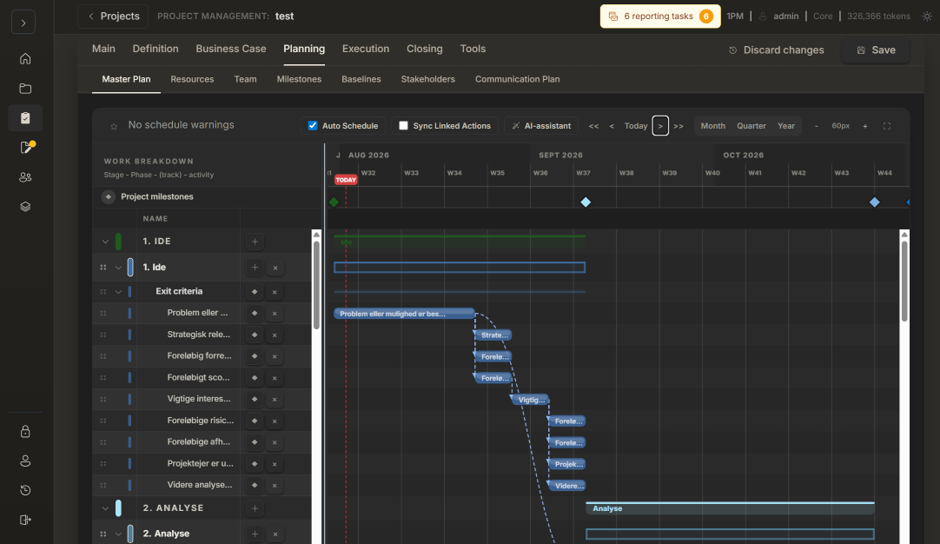
Plan inside the project model, not beside it
The Gantt plan is an integrated part of the project model, not an external scheduling tool. Stages from the selected project model form the structure for activities, milestones, responsibilities, dates and dependencies in the Master Plan.
This connects governance directly with execution. Project managers can plan the actual work within the required stage-gate structure, while status reporting, analysis and portfolio views use information from the same plan.
05
Combine structured planning with agile execution
Traditional project planning is valuable when projects need governance, milestones and long-term direction. Agile ways of working are valuable when teams need flexibility, short planning horizons and fast coordination. 1PM brings these strengths together in one connected operating model.
The Master Plan provides the stable overall framework for the project, while selected activities can be broken into connected actions and managed through weekly planning and kanban as the work moves closer to execution. Because those actions remain linked to the plan, teams can work dynamically without creating a second disconnected planning track. This allows teams to stay structured at management level and flexible in day-to-day delivery without maintaining separate plans.
06
Keep the entire project connected
Manage the project as one connected body of information. Objectives, scope, deliverables, planning, risks, stakeholders, economy, resources, issues, decisions and reporting are maintained within the same project workspace.
Information created during daily project management can be reused in overviews, AI analysis, status reporting and portfolio management. This reduces duplicate entry, improves consistency and makes it easier for users to understand the relationship between a project's foundation, current situation and reported status.
07
Manage risks before they become issues
Identify and assess uncertainty while there is still time to act. Risks can be registered with relevant assessments, ownership and mitigating actions, giving the project manager a structured basis for monitoring exposure throughout the project.
Risk information remains connected to project follow-up, status reporting and portfolio oversight. Significant risks can therefore be communicated without rewriting them in separate reports, while changes in the risk picture become visible to both project and portfolio management.
08
Engage stakeholders systematically
Move stakeholder management from an informal contact list to a structured management discipline. Register relevant stakeholders, assess their importance and use the communication plan to define how and when they should be engaged.
By connecting stakeholder analysis and communication planning to the project, the project manager can identify groups requiring particular attention and ensure that communication activities support delivery. This provides a stronger foundation for managing expectations, resistance, involvement and decision-making.
09
Monitor cost and financial development
Maintain a current picture of the project's financial position. Budget, actual costs and forecast information can be followed within the project, allowing the project manager to identify emerging deviations and communicate their expected impact.
Financial data becomes part of the same information base used for project follow-up, status reporting and portfolio analysis. This reduces the need to reproduce financial conclusions manually and gives management a clearer relationship between progress, remaining work and expected cost.
10
Manage issues, changes and decisions
Keep the events that shape the project visible and traceable. Current issues can be followed until they are resolved, proposed changes can be assessed and important decisions can be recorded with their context.
Managing these areas together helps explain why the project has changed and how current plans were established. It also prevents decisions and change history from being scattered across meeting notes, email conversations and separate registers.
11
Team Workspace – connect project planning with daily team execution
Turn the project plan into practical work that participants can act on. Actions can be created from the project context, assigned to users and connected to Master Plan activities so the daily execution stays linked to the formal plan.
Team Workspace brings Week Planner, Kanban, Action List, cross-project actions, comments and action history together around the same set of actions. Project managers keep visibility and control, while participants can manage and collaborate on the work they are responsible for across projects.
12
Start with the right priorities
Use Morning Brief to focus on what requires attention instead of manually reviewing every part of the project. The brief brings together relevant signals from the project and highlights overdue matters, risks, issues, gaps and possible next actions.
This gives the project manager a practical starting point for the working day and supports preparation for project meetings. Recommendations remain grounded in the project information already maintained in the system.
13
Report without rebuilding the project story
Prepare project status using the information already maintained through project management. Plans, risks, issues, economy and other project data provide the foundation for the report, reducing the need to recreate the same information in a separate reporting document.
The project manager can review the reporting picture, add the necessary management explanation and submit the report for the relevant portfolio period. Submitted reports are preserved as part of the project's reporting history.
14
Connect delivery with resources
Plan the resources needed to execute the project and submit allocation requests directly from the project context. Requests can specify the required resource or role, period and level of allocation.
The resource manager can review, adjust, approve or reject requests using the organization's shared resource information. This connects project planning with the resource-allocation process and provides a clearer view of whether the people required by the plan are actually available.